
October 21, 2026
Short answer: A home equity loan is a lump-sum second mortgage on your current house, with a fixed rate and fixed monthly payments that start right away. A bridge loan is short-term financing meant to carry you through the gap between buying your next home and selling your current one — repaid when the old house sells. They both tap the equity you’ve built, but they’re built for different jobs. If your goal is to buy before you sell, a bridge loan is designed for exactly that moment; a home equity loan isn’t.
Three ways to tap your equity — and why the difference matters
When you want to buy a new house before selling your current one, the money for the down payment is usually already yours — it’s just locked inside your home as equity. There are three common ways to reach it, and people mix them up all the time:
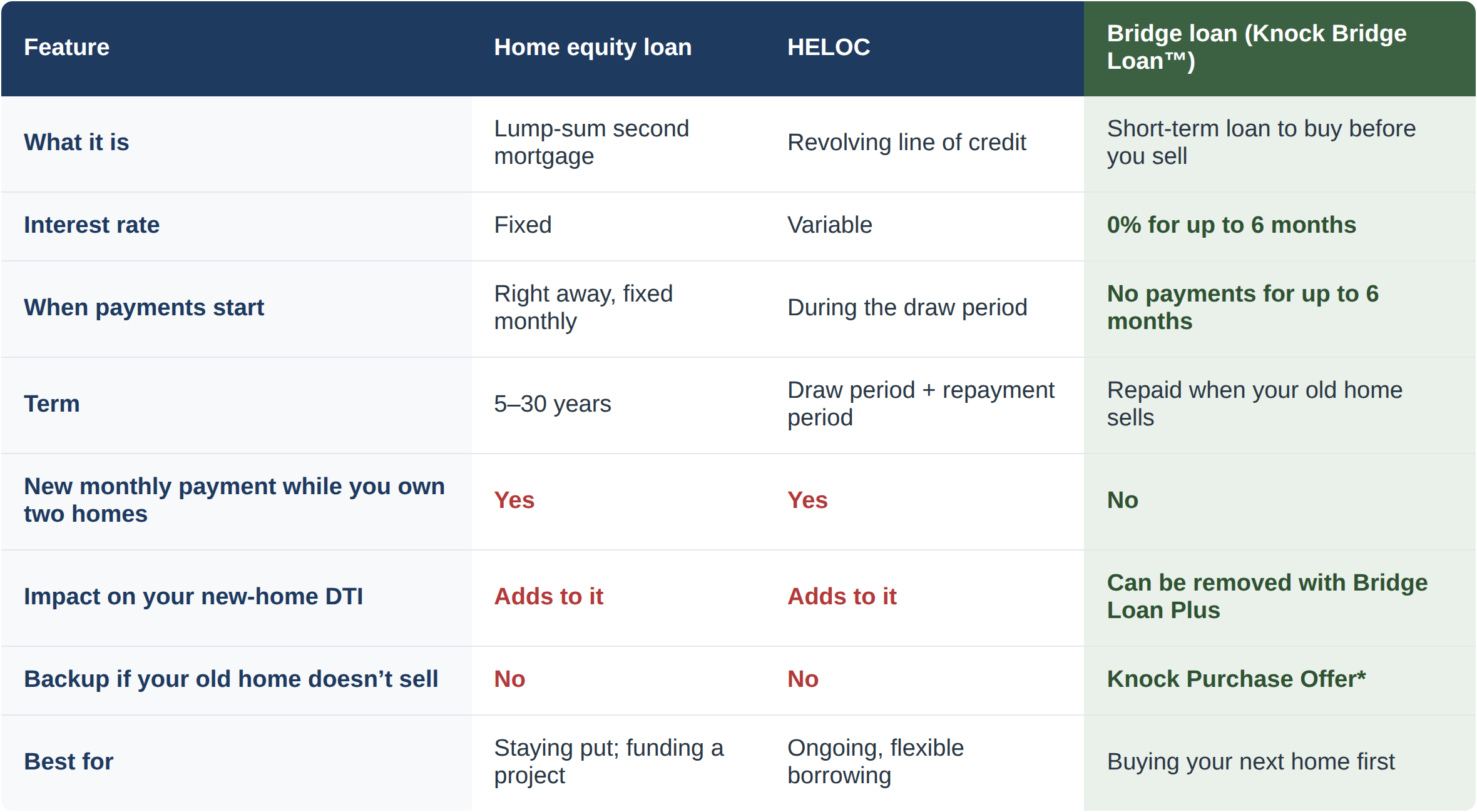
Home equity loan — a second mortgage that pays you a lump sum against your equity. Fixed interest rate, fixed monthly payment, repaid over a set term (often 5–30 years). Payments begin immediately.
HELOC (home equity line of credit) — a revolving credit line you draw from as needed, usually at a variable rate. You can read the full breakdown in our guide to what a HELOC is.
Bridge loan — short-term financing that bridges the timing between the two homes, repaid when your current house sells. The Knock Bridge Loan™ is a next-generation version built specifically for buying before selling.
The distinction matters because of one number: your debt-to-income ratio. When you apply for the mortgage on your new home, the lender adds up every monthly payment you owe. A home equity loan or a HELOC adds a brand-new monthly payment on top of your current mortgage — which can shrink how much you qualify to borrow on the next house. More on that below.
Home equity loan vs. bridge loan: the real differences
Here’s how the three options compare for someone buying a new house before selling the current one.
The Consumer Financial Protection Bureau explains the home equity loan vs. HELOC distinction in neutral terms if you want a deeper look at those two on their own.
Why a home equity loan gets awkward when you’re buying before selling
A home equity loan can be a fine tool when you’re staying in your home — say, to fund a renovation. But when you’re trying to buy a new house first, three things work against it.
First, the payments start immediately. The day your home equity loan funds, you owe a fixed monthly payment on it — on top of your existing mortgage, and soon on top of your new mortgage too. That’s potentially three payments at once.
Second, it raises your debt-to-income ratio at the worst possible time. That new second-mortgage payment counts against you when the lender sizes your next loan, so you may qualify for less house. (Here’s how debt-to-income works.)
Third, it’s still tied to your old home as collateral, and if your house takes longer to sell than you expect, you’re carrying that debt the whole time. A HELOC has the same core problem, plus a variable rate that can rise while you wait.
So which one makes sense when you’re buying a new house before selling?
If you’re asking the “home equity loan vs. bridge loan” question specifically because you want to buy a house before selling, a bridge loan is the tool built for that gap. It’s short-term by design, it’s repaid out of your home sale rather than out of your monthly budget, and the good versions don’t pile a new payment onto your plate while you own two homes.
That’s also what lets you make a strong, non-contingent offer — one that isn’t “subject to selling my current home.” Sellers treat those far more seriously. See what a non-contingent offer requires for why that matters in a competitive market.
How the Knock Bridge Loan™ helps
The Knock Bridge Loan™ was built to fix the exact problems a home equity loan creates for a move-up buyer. It unlocks up to $1,000,000 of your equity at 0% interest, with no payments for up to six months — you repay it when your old home sells. You can put those funds toward your down payment, buy down your rate, cover home improvements, or even cover payments on your departing home during the overlap.
Two more pieces make it cleaner than a home equity loan or HELOC:
Knock Bridge Loan Plus can remove your departing mortgage from your debt-to-income ratio, so carrying your current home doesn’t shrink what you qualify for on the next one.
If your old home doesn’t sell within six months, the guaranteed Knock Purchase Offer buys it at a price agreed up front,* so you’re never stuck carrying two homes indefinitely. (In fact, 92% of Knock customers sell their home in under 90 days.)
The result is the thing a home equity loan can’t give you: the ability to buy your next home first, with one lender, no new monthly payment during the bridge, and a safety net underneath.
Frequently asked questions
Can I use a home equity loan to buy another house? Technically yes — a home equity loan gives you a lump sum you could put toward a down payment. The catch is that you then carry its fixed monthly payment on top of your current mortgage and your new mortgage, and that payment counts against your debt-to-income ratio when you qualify for the new loan.
Is a bridge loan cheaper than a home equity loan? It depends on the bridge loan. Traditional bridge loans can carry high interest rates and origination fees. The Knock Bridge Loan™ charges 0% interest with no payments for up to six months, so you’re not paying interest month to month while you wait for your home to sell.
What’s the difference between a home equity loan and a HELOC? A home equity loan is a one-time lump sum at a fixed rate with fixed payments. A HELOC is a revolving line of credit you draw from as needed, usually at a variable rate. Our HELOC guide covers that comparison in detail.
Do I have to sell my current home first to get a bridge loan? No — that’s the entire point. A bridge loan lets you access your equity and buy your new home before your current one sells, then you repay the loan once the sale closes.
Does a bridge loan hurt my chances of qualifying for a new mortgage? It can actually help compared with a home equity loan. With Knock Bridge Loan Plus, your departing mortgage can be removed from your debt-to-income ratio, which can increase your buying power rather than reduce it.
Key takeaways
A home equity loan is a fixed, lump-sum second mortgage with payments that start immediately — good for staying put, awkward for buying before selling.
A HELOC is a revolving, variable-rate line of credit with the same two-payment problem.
A bridge loan is short-term and repaid when your old home sells, so it’s purpose-built for buying your next house first.
The deciding factor is usually debt-to-income: home equity loans and HELOCs add a payment that counts against you; the Knock Bridge Loan™ is structured to avoid that.
Ready to see what your equity could do before you sell? Check your eligibility with Knock in a few minutes.
* The Knock Purchase Offer is a written, non-contingent offer from Knock Property 1, LLC to buy your home at an agreed price. Knock Property 1, LLC — a wholly-owned subsidiary of Knock Lending LLC (NMLS #1958445) — is the entity that makes the Knock Purchase Offer and that would purchase the home. You are not required to use Knock Lending or any Knock affiliate.